Imagine becoming famous because the newspapers said you were dead.
In 1971 Philadelphia, a teenager named Darryl McCray discovered that another boy's murder had been mistaken for his own. The victim was 17-year-old Cornelius “Corn” Hosey, killed in West Philadelphia. McCray, better known as Cornbread, was alive, furious and already so notorious for writing his name across the city that an error involving a similar nickname had taken on a life of its own.
He could have demanded a correction. Instead, according to the story he has told for decades, he went to the Philadelphia Zoo and wrote two words on the side of an elephant: Cornbread Lives.
It is an outrageous scene, part survival announcement, part publicity stunt, part adolescent theater. It also raises an uncomfortable question about the animal, which did not volunteer to become a billboard. But underneath the legend sits something larger and more interesting: a Black teenager from North Philadelphia had discovered how to make the entire city repeat a name that did not belong to anybody famous.
Years before graffiti became synonymous with New York subway cars, before hip-hop acquired a familiar visual identity, and long before corporations sold rebellion back to the people who invented it, Cornbread had worked out an astonishingly modern rule: visibility can manufacture reputation.
I. A nickname that was supposed to embarrass him
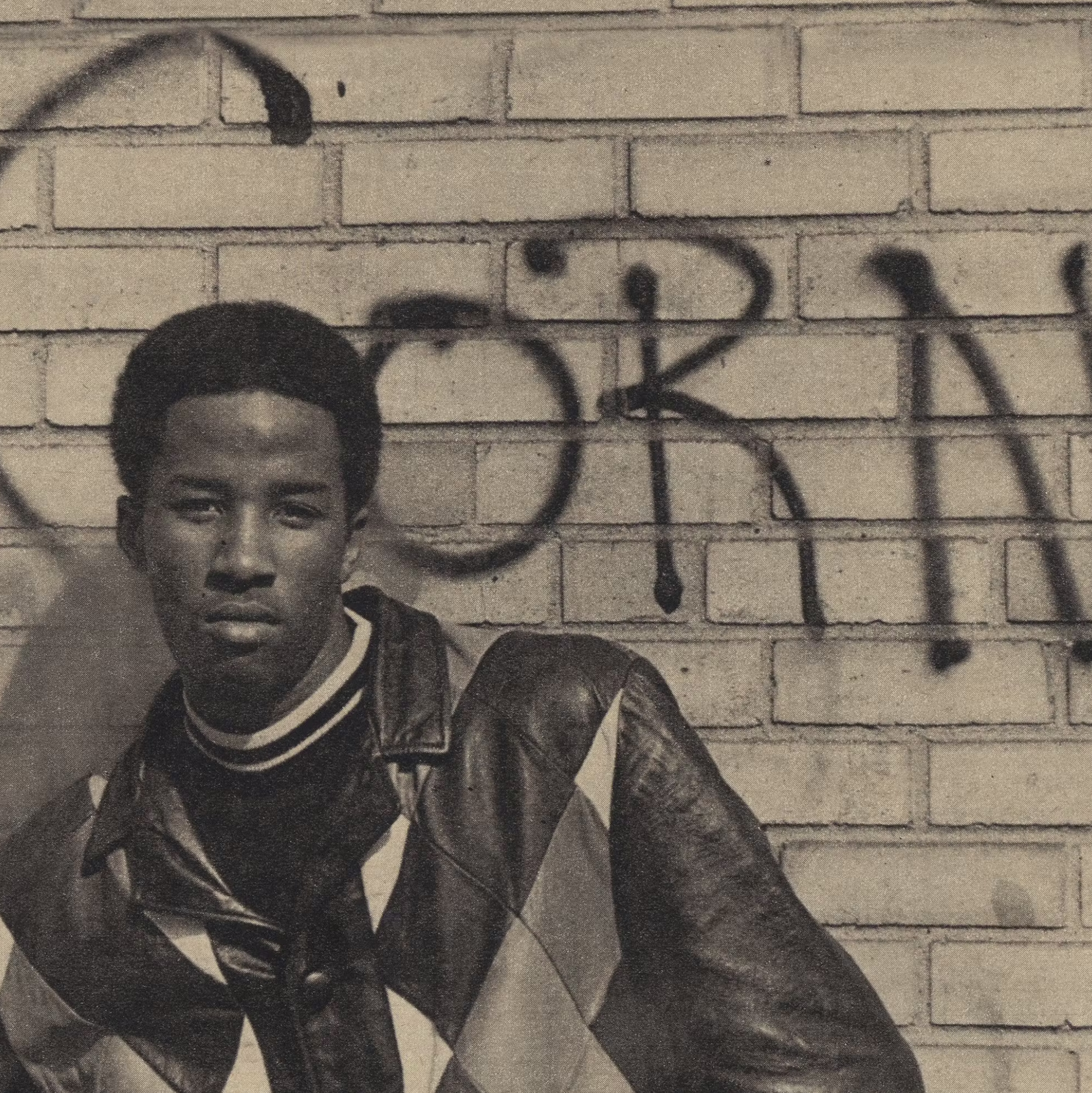
Start in the Youth Development Center in Philadelphia in the mid-1960s, not on a subway platform. McCray was a child from Brewerytown who had entered juvenile detention. He missed the cornbread his grandmother made. The institutional version did not meet his standards, and he kept pestering the kitchen for something better. One day, the cook, remembered in later accounts as Mr. Swanson, dragged him out and told a counselor to keep this “cornbread” out of his kitchen.
The cafeteria laughed. The nickname stuck. McCray took the insult and made it his signature.
That transformation is the first twist in the Cornbread story. The very thing intended to put him in his place became something he controlled. He began writing the name on the back of his shirt and throughout the detention center, initially with markers. The point was not to draw a beautifully detailed mural. It was to make his presence impossible to ignore. In a 2019 WHYY interview, he described the moment the nickname became a written identity.
The dates are commonly given as 1965 for those early institutional markings and 1967 for the campaign that followed his release. He did not invent putting words on walls. People had scratched names, slogans and political declarations into public space for centuries. What he helped pioneer was a specifically modern practice: repeatedly writing a chosen identity across a city in pursuit of recognition, independent of a gang's territorial claim.
A child who had spent time being told where he could and could not go found a way to be everywhere.
II. The first campaign was a love letter
There is a small human detail that often gets lost beneath the zoo headlines. Early in Cornbread's career, a classmate named Cynthia became the center of an enormous, very public crush. “Cornbread Loves Cynthia” appeared along routes through Philadelphia, turning bus stops and neighborhood surfaces into messages a schoolgirl might encounter on the way home.
This was not discreet courtship. This was a teenage boy using the geography of a city to make his feelings unavoidable. It could feel romantic, awkward or overwhelming depending on where you stood; the gesture is best understood as youthful bravado rather than an instruction manual for romance. As a piece of cultural history, though, it reveals that tagging was never only about intimidating territory. It could also be about longing, embarrassment, humor and trying to be seen.
Amsterdam's STRAAT Museum identifies the campaign as an early signature of his work and notes a long creative echo: artist Stephen Powers, known as ESPO, later created A Love Letter for You along Philadelphia's Market–Frankford line. Those murals are not by Cornbread, nor are they direct copies of his lettering. What connects them is a proposition that seems obvious only after somebody tries it: a transit route can carry intimate words to thousands of strangers.
Think about the escalation. First an insult became a name. Then a name became a message. Then that message became a citywide mystery. Who was this kid? Why did every bus route seem to know him?
III. He did not need an audience. He built one.
McCray was unusually conscious of how the city moved. In a 2024 WHYY oral-history interview, he described deliberately walking bus routes: a rider would see his name on the way to work, then encounter it again coming home. He understood repetition and reach before either became part of an advertising pitch.
The surfaces grew more audacious: street signs, benches, buses, taxis, police vehicles, trucks, trains and buildings under construction. In some accounts, he reached difficult, dangerous high spots to prove that the name could appear where others would not dare place theirs. The public was not simply viewing a mark. It was following a running story about its maker.
Writers call it “getting up,” but that phrase barely captures the ambition. He wanted people who had never met him to talk about him. A city became his distribution network. Every commuter was a potential witness, every erased mark a reason to make another.
There was a cost. Property owners had to clean the work, authorities treated it as vandalism, and a young man was being celebrated for behavior that created problems for other people. Cornbread's innovation is historically significant without requiring us to call every act harmless. The tension between self-expression and public ownership was there from the beginning.
IV. The newspaper buried the wrong Corn
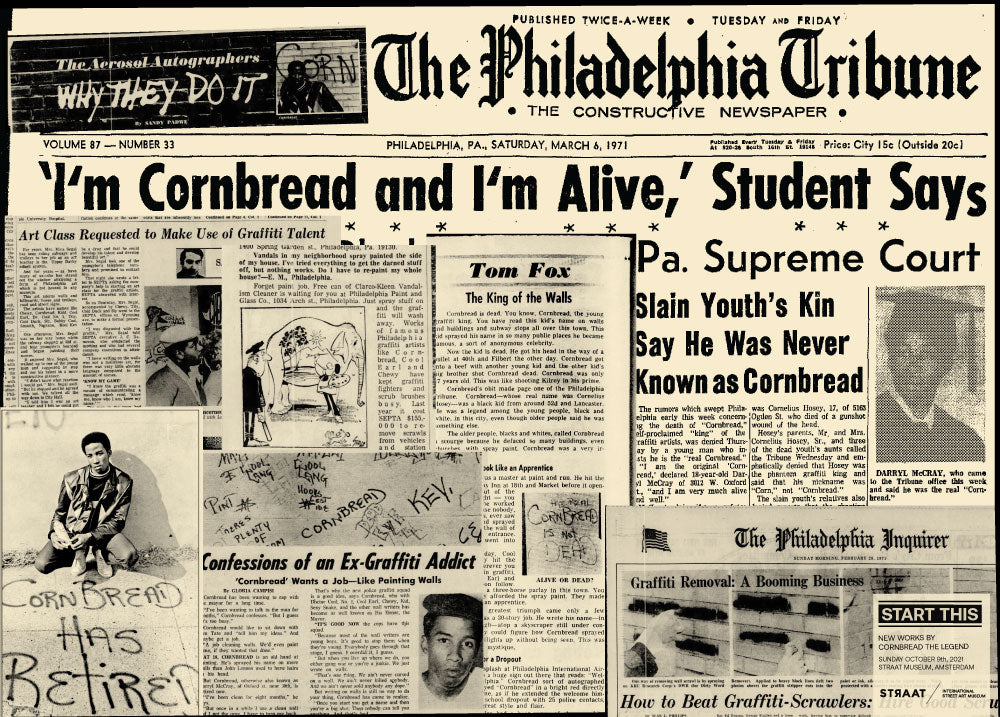
The event that pushed Cornbread's reputation into folklore began with a real death. Cornelius Hosey, a West Philadelphia teenager also known as “Corn,” was murdered in February 1971. Contemporary reporting blurred the two names. Scholarship assembled by Picturing Black History identifies Hosey, the newspaper confusion and the ensuing notoriety. A young person's killing deserves more than a punch line in the biography of somebody who survived him.
McCray learned that he was supposedly dead. He contacted newsrooms and WDAS radio to correct the mistake. But the false report also challenged the persona he had spent years building. A name that had made him famous could suddenly be detached from its living owner.
So he staged an announcement of survival larger than a newspaper correction. The story's signature line, “Cornbread Lives,” was written on an elephant at the Philadelphia Zoo. Accounts differ on some details of the episode, and The Philadelphia Inquirer reported in 2016 that neither the zoo nor police had located a record specifically documenting McCray's claim. The newspaper did find an April 1971 report of an elephant painted by a graffiti writer, while Cornbread and other early writers maintained his account.
That is the distinction worth preserving: a documented period incident, a long-running first-person claim, corroborating memories and an incomplete official paper trail. It is not necessary to invent a photograph of the elephant or pretend every element has been proved to understand why the episode became famous.
The obvious emotion is relief: a teenager, wrongly reported dead, insisting that he is still here. The less comfortable emotion is anger. The city knew his name well enough to pronounce him dead but not well enough to be certain who he was.
V. The elephant and the airplane
A man writes his name on a zoo elephant. Another story places him beside a jet carrying the Jackson 5, where he says he left the same signature. Both stories sound almost engineered to become anecdotes told in barber shops for the next fifty years. They are extravagant precisely because the objects do not belong in ordinary graffiti territory: an animal and a famous band's airplane are both too improbable to ignore.
Cornbread has repeatedly told both stories, and they appear in institutional histories including STRAAT's exhibition account. However, the existence and exact details of the plane episode are not independently established by the reporting cited here. The evidence for the elephant incident is stronger, though still qualified. We should resist polishing legend into certainty.
The elephant story also feels different now than it may have to a teenager fighting for attention. Spraying an animal is not a charming prank to imitate. The zoo's elephant was a living creature, not a neutral canvas. Recognizing the harm does not erase how the stunt changed graffiti history. It allows the story to be both outrageous and ethically legible.
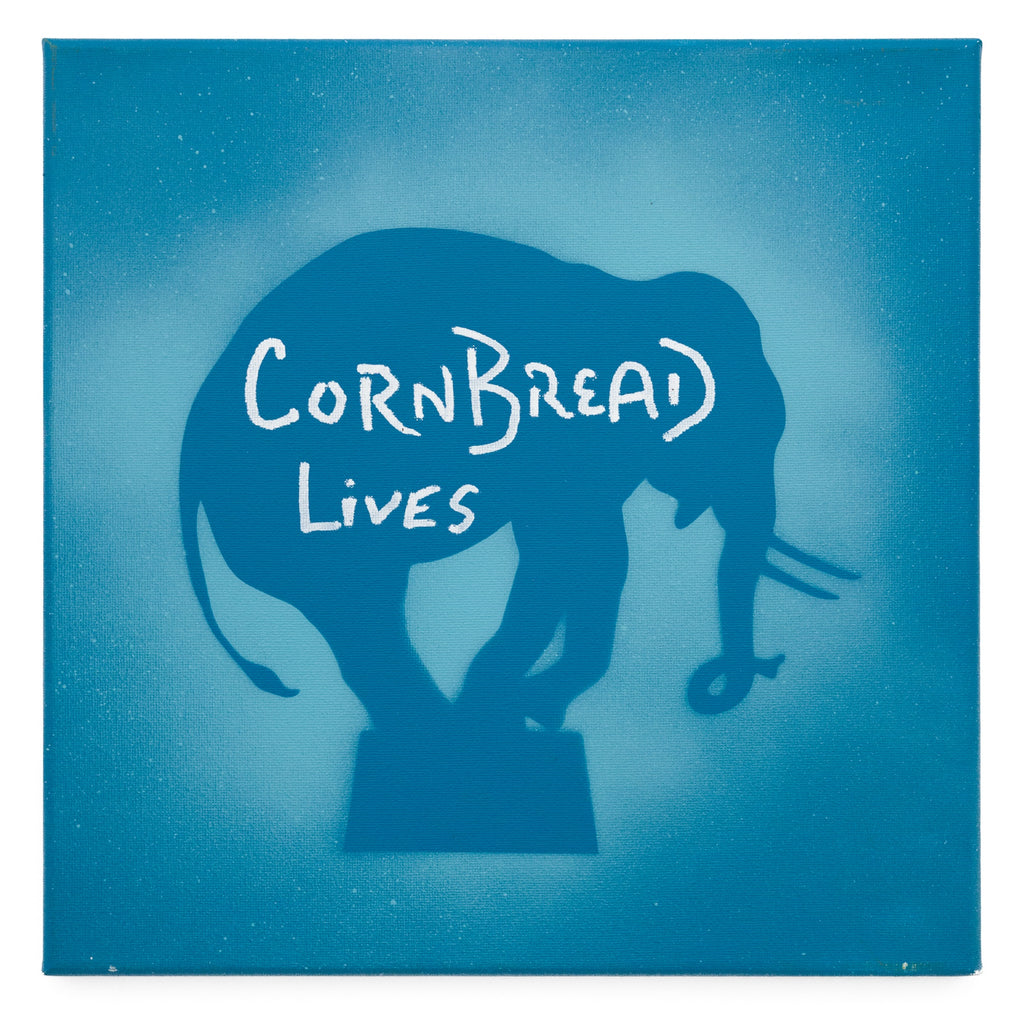
What really traveled was not the paint. It was the account of the paint. In a culture before social feeds, he understood something creators still chase: if a stunt is impossible to forget, other people will become its broadcasters.
VI. Philadelphia before the New York origin story
Ask a casual observer where modern graffiti began and New York often supplies the answer: subway trains, spray-painted names and the celebrated 1971 New York Times profile of TAKI 183. New York transformed writing into an internationally legible visual language, especially through the speed, scale and photographic drama of the subway system. Those contributions cannot be reduced to a footnote.
But Philadelphia was writing a crucial earlier chapter. Cornbread's mid-1960s practices preceded the subway movement's most famous publicity. Other Philly writers, including Kool Klepto Kidd and King Lewis, also belong in the history. The deeper question is not who was the first human to write on a wall, which no modern artist can plausibly claim. It is when a distinctive, competitive culture of repeatedly circulating one's chosen name became an identifiable practice.
That is where Cornbread's case is strongest. The claim “world's first modern graffiti writer” is a widely used honorific, not a settled mathematical proof. It acknowledges a pioneering form of individual name-writing that was not principally gang marking. Interviews accompanying Roger Gastman's Wall Writers documentary show that even early participants disagreed about how neatly Philadelphia and New York can be ranked.
Trying to assign a single inventor to a cultural practice is often less illuminating than examining the conditions that allowed it to spread. Philadelphia had the handstyles, the young writers, the bus and trolley routes, the local rivalries and the hunger for recognition. New York later developed its own dazzling systems of scale and style. The story becomes richer when the cities are allowed to have distinct histories instead of fighting for one trophy.
VII. When the police learned to read his name
Every new cultural language creates its own opposition. For Cornbread's generation, that opposition included police surveillance, arrests and the city government's determination to remove tags from public property. Picturing Black History records Philadelphia's creation of a dedicated graffiti squad in 1971, with 10 plainclothes officers, and hundreds of vandalism arrests in the following two years. Officials described significant cleanup costs. The writers saw police attention as further proof their activity was being noticed.
There is something tragic about the symmetry. Cornbread began writing because being noticed felt powerful. Eventually the machinery of the city noticed too. A signature that gave him a new public identity could also lead directly to a charge, a police record or an argument about what public space was for.
His early life was not an uncomplicated triumph. His later interviews discuss problems with the law, addiction and rebuilding his life. In a long-form conversation published by The Philly Blunt, he speaks candidly about both the trouble and the subsequent work with young people. These parts of the biography matter because the public mythology can otherwise make attention sound like an uncomplicated form of freedom.
VIII. The walls entered the museum
Decades later, a strange reversal unfolded. What once prompted arrest began appearing under gallery lights. Cornbread's name migrated from buses and street signs to curated exhibitions, collections, talks and international museums. At Philadelphia's Paradigm Gallery in 2019, he wrote on salvaged signs and commercial objects, bringing the old impulse into a setting where visitors were invited to study it as art. WHYY reporter Peter Crimmins documented that exhibition.
New York's Beyond the Streets placed him inside a broader graffiti history, with photographs, press clippings and artifacts that made his early career easier to examine. The installation presented a useful irony: the same newspaper coverage that made graffiti notorious had become material for understanding why it mattered.
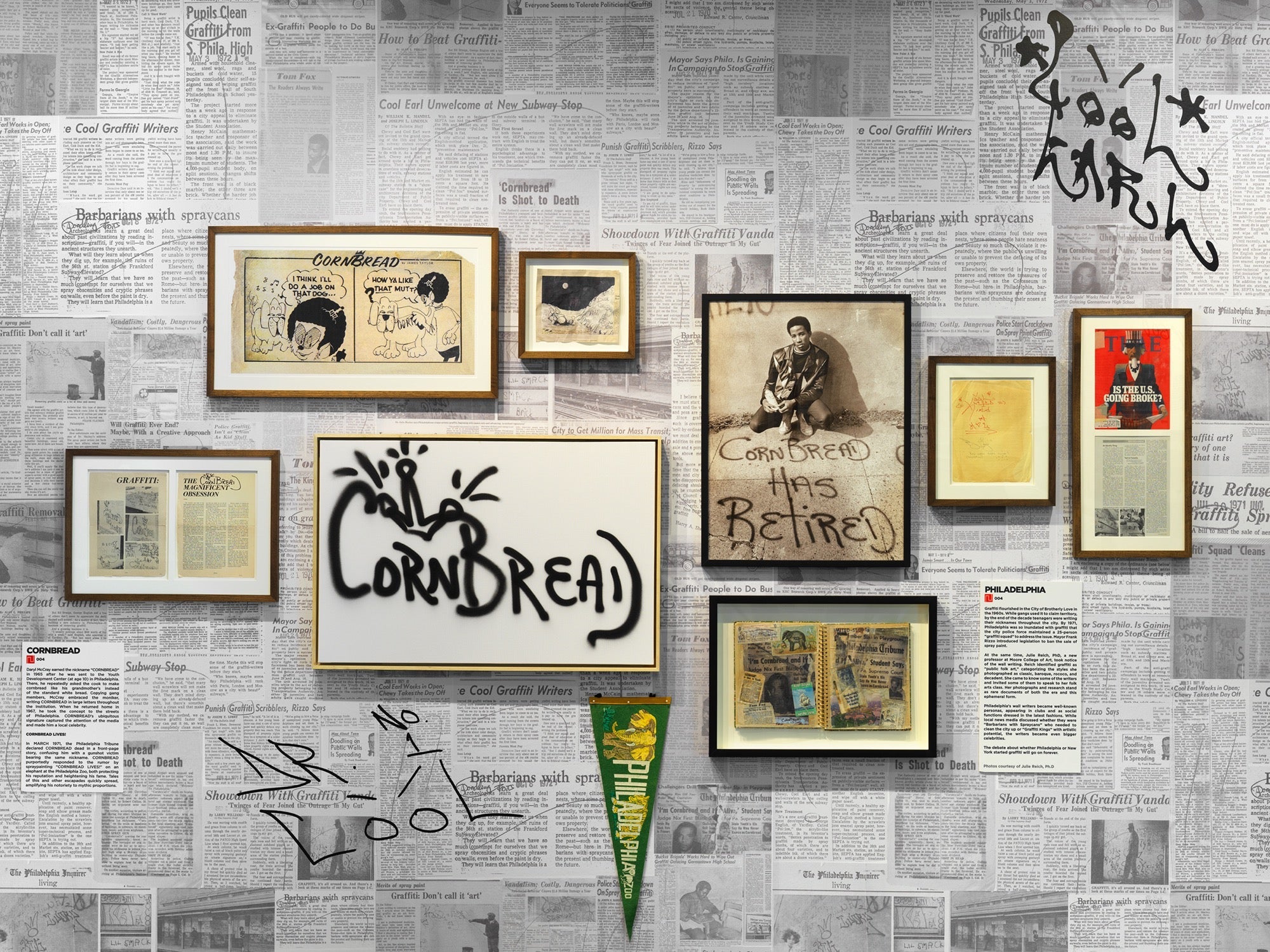
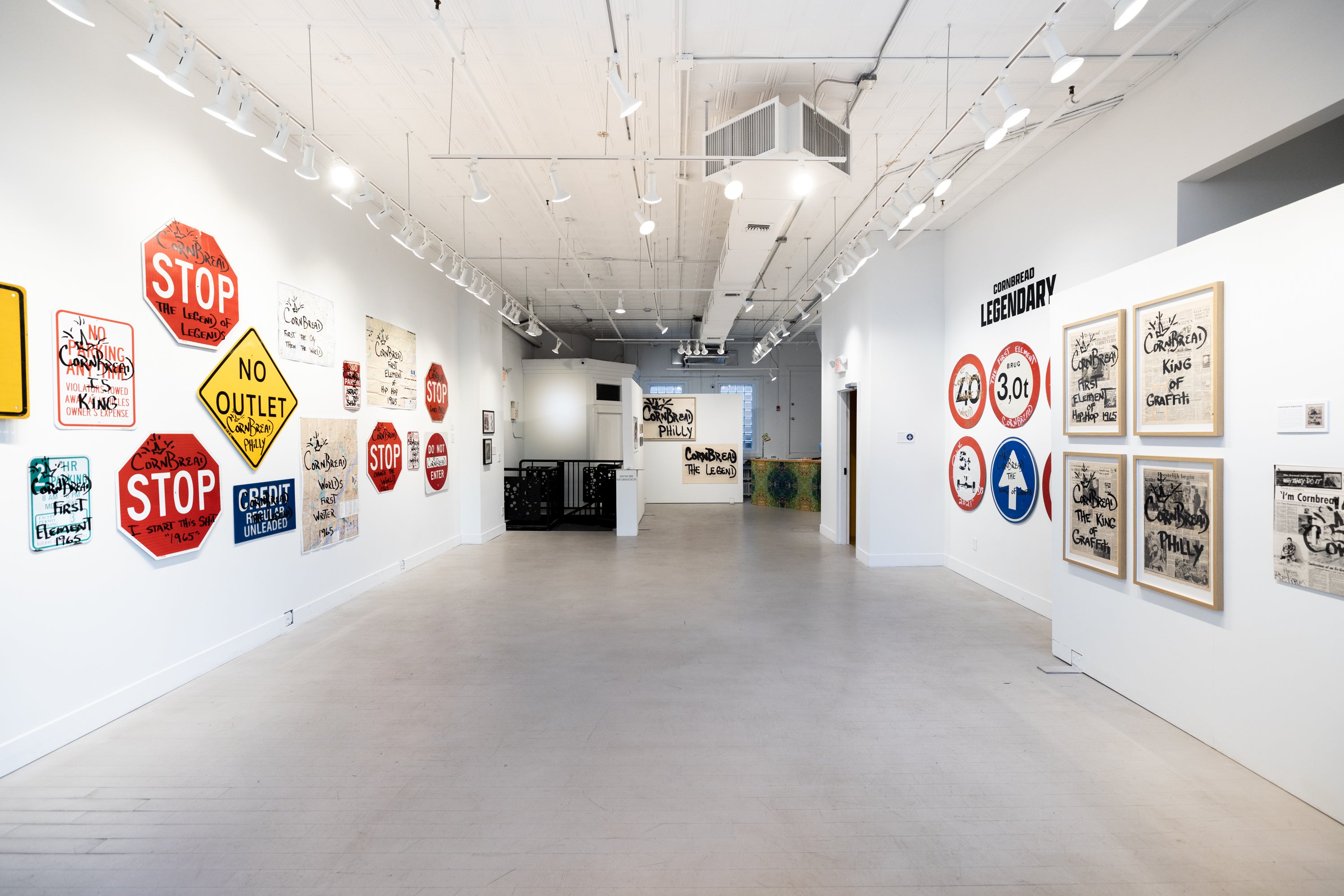
His solo show START THIS at Amsterdam's STRAAT Museum put the Philadelphia writer before an international audience. In 2026, Paradigm's Legendary exhibition assembled more than a hundred works and celebrated the addition of his work to The Hip Hop Museum's collection. The exhibition dates were January 16 through February 15, 2026.
When the street sign became the artwork
Here is the part of Cornbread’s career that would have sounded like a practical joke to a Philadelphia cop in 1971: today, you can buy the stop sign. Not the one somebody caught him writing on half a century ago, but a retired traffic sign transformed into an original work by the man himself. The same red octagon that once told the public to stop now carries the handwriting of an artist who built his reputation by refusing to disappear.
In Wynwood Art Gallery’s Cornbread collection, pieces with names such as I Start This Shit “1965”, Change The World “1965” and Philly Stop Sign are listed among a selection of original signs. At the time of this article update, the gallery displayed asking prices from approximately $1,500 to $3,000. Those are advertised prices, not verified sales or evidence of what every Cornbread work is worth. The “1965” lettering looks backward to the beginning of his writing career; it is not necessarily the production year of the object. For example, a related Change The World 1965 Stop Sign offered through Paradigm Gallery + Studio is documented as a 2024 artwork.
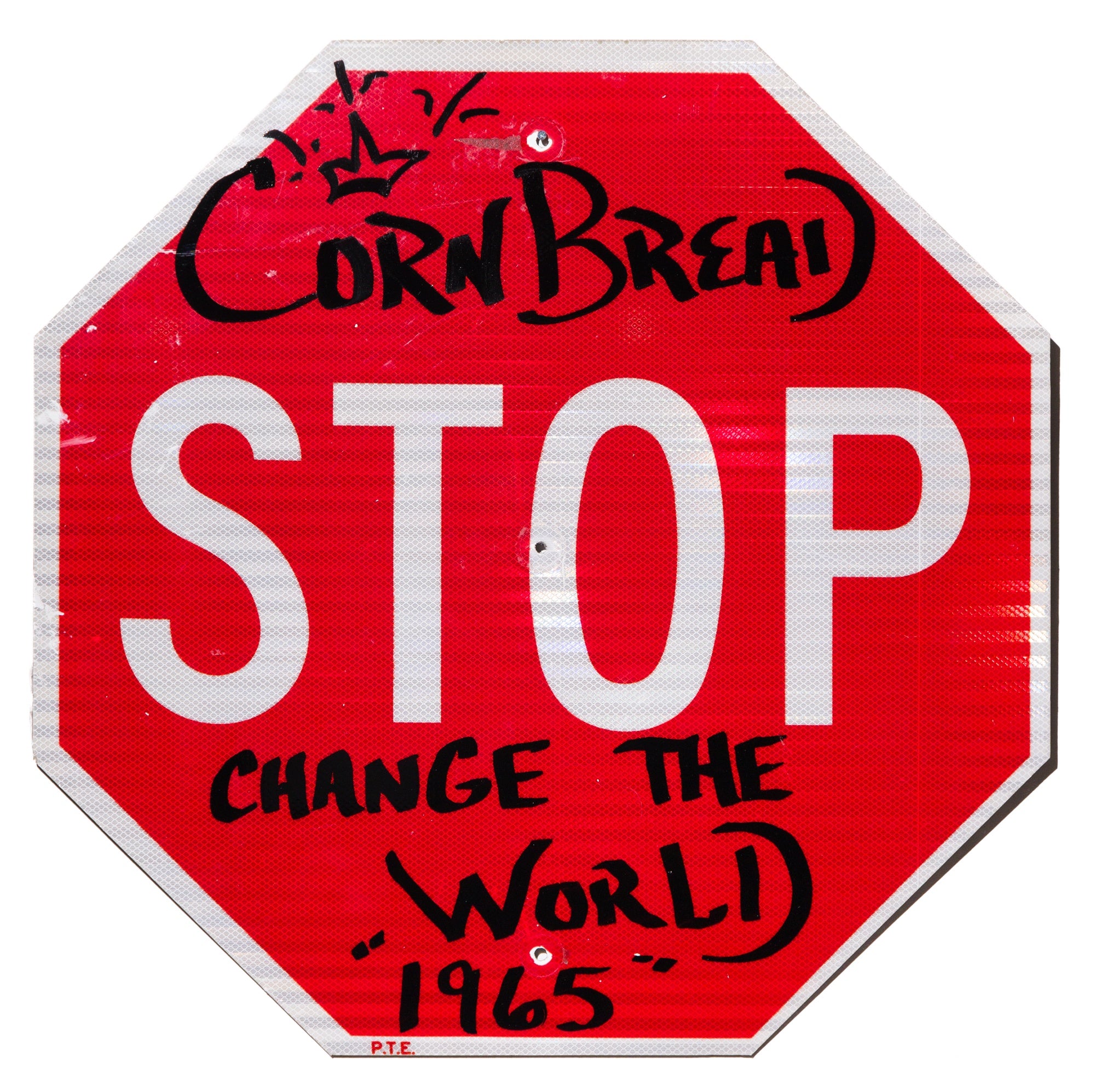
The change is remarkable, though it raises a harder question than whether somebody will pay three thousand dollars for a painted sign. Who gets to decide when writing on a street sign becomes art? An unauthorized mark can cost a property owner money and earn its maker an arrest. A legally obtained, retired sign bearing the same handstyle can acquire an exhibition label, a certificate and a collector. The surface is familiar; the chain of permission, ownership and exchange is entirely different.
That does not mean Cornbread simply sold out or that collectors somehow invented the value of his work. The neighborhood audience, the early writers, and the people who remembered his name had already given the signature cultural weight. Galleries can convert that reputation into objects with asking prices, while collectors can help preserve work that would otherwise be painted over or lost. There is room to admire the survival and still ask who benefits financially, what gets saved, and what vanishes when street culture is removed from the street. The teenager wanted his name all over Philadelphia. The elder can now watch a version of that name travel home in somebody else’s collection.
The transformation from graffiti offender to exhibited artist is not just a success story. It exposes how institutions decide which marks count as valuable. An unauthorized signature can be considered damage; a signature on a prepared panel can be collectible. The hand, the name and the intention may be the same. Context changes the verdict.
IX. The writer who now tells people to leave murals alone
In November 2024, the Inquirer reported that McCray was urging people to stop defacing Philadelphia murals. The pioneer who had once treated the city as an enormous surface for his signature was now worried about vandals damaging public artworks. He had become an advocate and mentor, with a relationship to the city's Mural Arts community.
That sounds like a contradiction until you consider what experience does to a person's understanding of value. A teenager may focus on the thrill of a mark surviving long enough to be seen. An elder may see the weeks of work, community fundraising and local memory invested in a mural someone else can destroy in seconds. Both are questions about whose expressions deserve space. Their answers need not remain fixed over a lifetime.
The irony also makes Cornbread more interesting than a perfect pioneer. He is a person who lived long enough to argue with the consequences of a culture he helped shape.
X. Why his name still travels
There are at least three ways to read Cornbread's contribution. As an artist, he made his name into a repeated public image. As a strategist, he recognized the power of distribution, frequency, surprise and word of mouth. As a young Black Philadelphian navigating institutions that did not offer him fame or influence, he fashioned a kind of visibility available without a record deal, newspaper column or gallery contract.
That does not make graffiti a frictionless democratizing force. Cities contain other people, and the right to expression exists beside responsibilities to property, neighborhoods and the living beings caught in the performance. His legacy is more powerful when those frictions remain visible.
But consider the distance. A cook used the word “Cornbread” to embarrass a boy. That boy wrote it on his shirt. Then on walls. Then across bus routes. The police recognized it. The newspapers repeated it. Decades later, an Amsterdam museum displayed it. In Philadelphia, where a spray-painted name was once evidence of a problem, the same name became part of the city's cultural inheritance.
The joke is on the people who assumed a nickname was all he would ever be.
Where to keep reading
This account draws on WHYY's 2024 interview at the Philadelphia Zoo, Picturing Black History's chronology, the Inquirer's investigation of early wall writers, STRAAT Museum's exhibition history, and Paradigm Gallery's 2026 exhibition records. For the broader East Coast story, see Fresh Fuzion's Philadelphia's Other Rap History and Underground History of New Jersey Hip-Hop.
Editorial and image note: The “world's first” title is an honorific with important historical qualifications. The elephant story is supported by contemporaneous press reporting about a painted zoo elephant and by accounts from McCray and peers, though an official contemporaneous record conclusively naming him was not established in sources reviewed. The images above reproduce archival material and artworks attributed to their publishers, exhibition organizers and identified photographers; attribution alone does not establish permission for reuse. Verify image licenses or secure republication approval for continuing publication.